Source-grounded visitor guide • Timings require current confirmation
Opening: approximately 5:30 AM
Sacred river: Godavari source tradition
Hill route: check weather and access
Rituals: use authorised channels
Planning note: crowd guidance is not a live queue reading.
Jyotirlinga No. 8
Shri Trimbakeshwar Jyotirlinga Mandir
Trimbak, Nashik District, Maharashtra
Deity: Lord Shiva as Trimbakeshwar Jyotirlinga
Meaning: “The Three-Eyed Lord” Tri — Three · Ambaka — Eyes · Ishwar — Lord Temple tradition also associates the Jyotirlinga with the Trimurti of Brahma, Vishnu and Shiva.
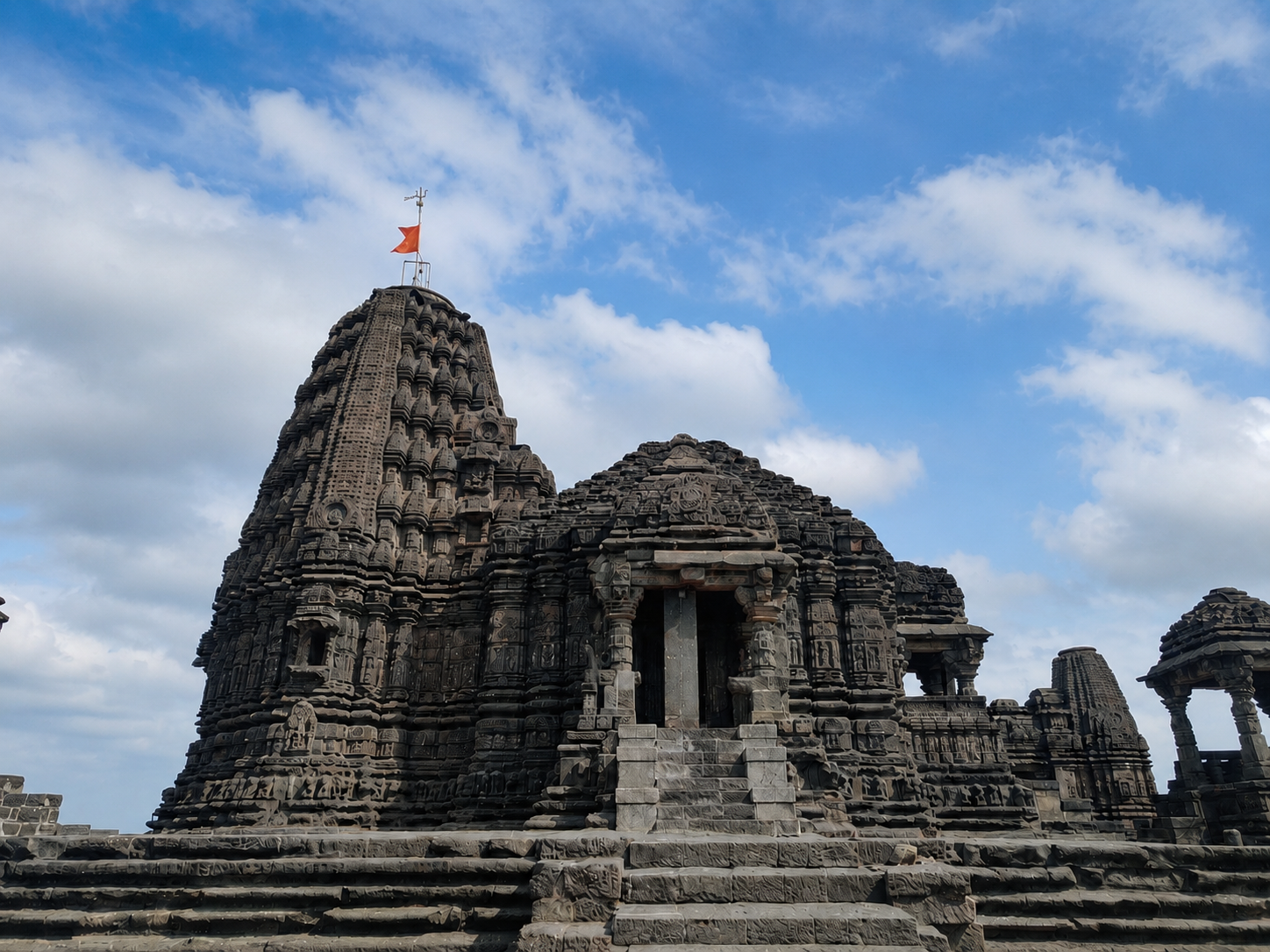
Trimbakeshwar is one of the twelve Jyotirlingas, worshipped at Trimbak beside the Godavari source landscape and Brahmagiri Hills. The present black-stone Mandir is an eighteenth-century Peshwa-period structure with Hemadpanthi influence.
Plan around published ritual periods and current Mandir controls. Crowd and best-window guidance is for planning, not a live queue reading.
Darshan Start
6:00 AM onward
General planning time, subject to current arrangements.
Crowd Expectation
Allow flexible time
Shravan, Mondays, festivals and Kumbh arrangements may be busier.
Best Darshan Window
Arrive early
October to March is the general planning season.
Planning recommendation
Ritual Planning
Confirm before payment
Verify priest, materials, eligibility, duration and charges.
Timings can change during festivals, Shravan, Kumbh arrangements and special ritual days.
Source basis: supplied Trimbakeshwar content document and cited reference notes.
Jyotirlinga No. 8One of the twelve sacred Jyotirlingas.
Sacred identity and landscape of Shri Trimbakeshwar Jyotirlinga Mandir at Trimbak.
Dedicated to Lord Shiva and revered as the eighth Jyotirlinga among the twelve Jyotirlingas.
Located at Trimbak in Nashik District, Maharashtra, at the foothills of Brahmagiri Hills.H5
Closely connected with the origin of the Godavari River, revered as Dakshin Ganga.R12
Known for its unique Jyotirlinga, ancient rituals, black-stone architecture, sacred water tanks and Vedic traditions.
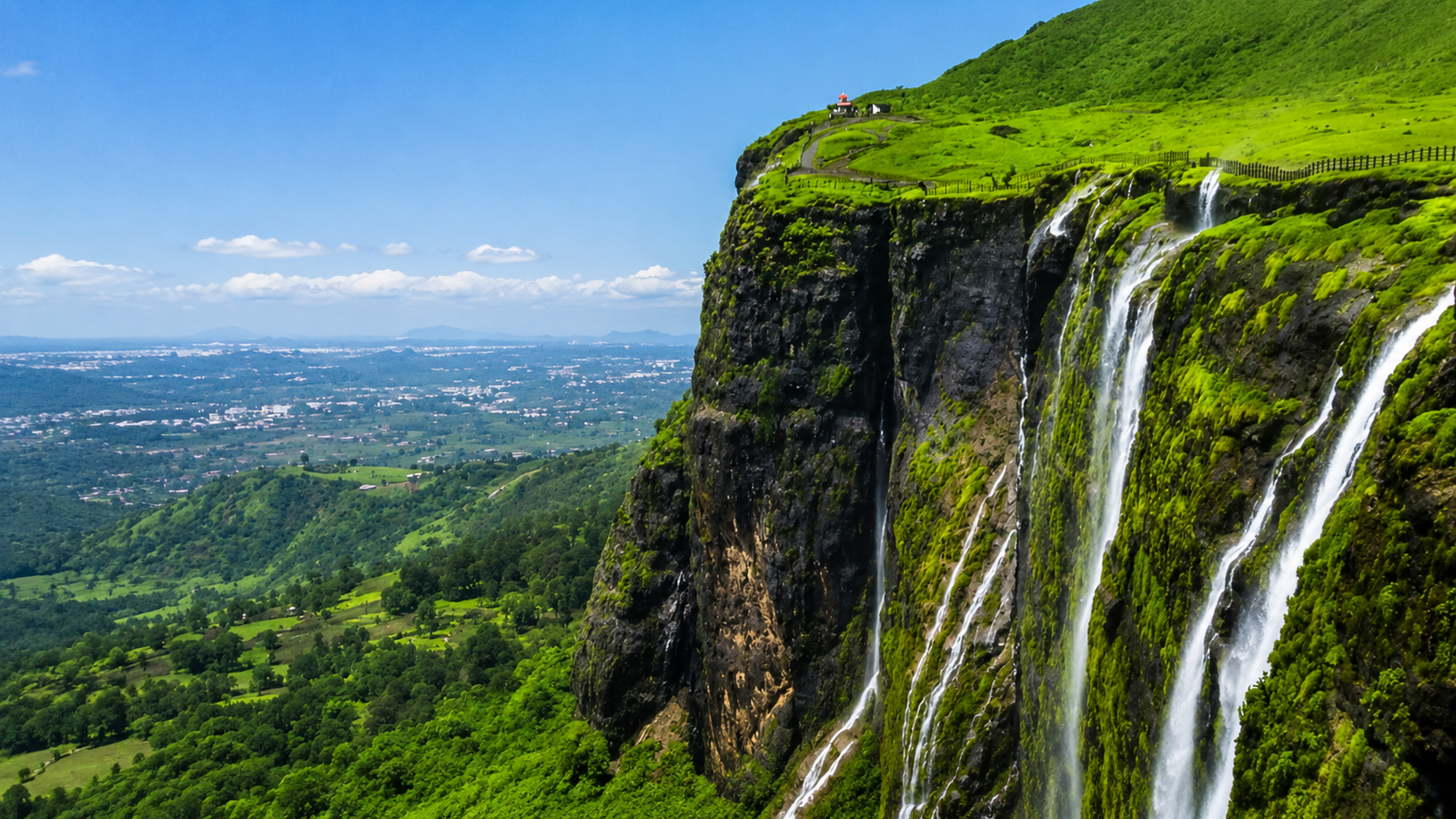
Surrounded by hills, forests, holy kunds and ancient pilgrimage routes in the Western Ghats landscape.H12
Trimbakeshwar joins Shiva worship, the Trimurti tradition, the Godavari source, Brahmagiri pilgrimage, Vedic practice and ancestral remembrance within one sacred landscape.
The Mandir remains one of India’s important spiritual destinations and river-pilgrimage centres.
Mythology of Sage Gautama, Ahilya, Ganga and Godavari
A Hindu sacred tradition of penance, purification, the descent of Ganga and Shiva’s manifestation as Trimbakeshwar.
Sacred origin tradition
Sage Gautama Maharishi and his wife Ahilya lived near Brahmagiri Hills. Through penance and righteousness, Gautama earned divine blessings. The tradition says jealous sages falsely accused him of committing a sin. Seeking purification, Gautama prayed intensely to Lord Shiva.
Pleased with his devotion, Shiva appeared before Gautama. Gautama requested the descent of holy Ganga.R11 Shiva is believed to have brought the divine river to earth in the form of the Godavari and then manifested as Trimbakeshwar Jyotirlinga, establishing the site as a major Shiva pilgrimage.
Penance and righteousness
Gautama and Ahilya
The couple are remembered in the Brahmagiri sacred tradition.
Divine river
Ganga as Godavari
Gautama’s prayer is linked with the Godavari’s sacred descent.
Shiva’s manifestation
Trimbakeshwar Jyotirlinga
The tradition culminates in Shiva’s Jyotirlinga manifestation.
Historical Importance
A centuries-old centre of Shaivism, Vedic learning, river worship, pilgrimage and ancestor rites.
Peshwa-period reconstruction
The supplied source identifies the present Mandir as an eighteenth-century reconstruction by Nanasaheb Peshwa, also known as Balaji Baji Rao, of the Maratha Empire.REC The reconstruction enhanced the architecture while preserving the site’s ancient sanctity.
Trimbakeshwar and Nashik are among the four sacred Kumbh locations. The Nashik–Trimbakeshwar Kumbh attracts pilgrims, saints and ascetics from India and abroad.C12
Ancient pilgrimage centre
Living sacred continuity
Shaivism, Vedic learning, river worship, pilgrimage traditions and ancestor rites remain central.
Eighteenth century
Nanasaheb Peshwa
The surviving black-stone structure belongs to the Maratha and Peshwa-period context.
Major pilgrimage gathering
Simhastha Kumbh
The region hosts one of the world’s largest religious gatherings approximately every twelve years.
Mandir Architecture & Design
Black basalt Hemadpanthi architecture with an east-facing approach and a central stone sanctum.
Sacred design
The Mandir is built in the traditional Hemadpanthi architectural style of medieval Maharashtra.AR8 Its massive dark-stone construction, intricate carvings, decorative pillars, ancient sculptures, sacred water tanks, courtyards and ornate gateways create a powerful and majestic atmosphere. The source also records a gold crown offered to the deity.
The main entrance and temple orientation face east, symbolising divine light and spiritual awakening. Pilgrims proceed through the eastern gateway toward the Garbhagriha, where the Jyotirlinga is housed in a deep stone chamber at the central sanctum. The Nandi Mandap faces the sanctum.
Stone tradition
Black basalt Hemadpanthi design
Substantial masonry, carvings, pillars, sculptures, tanks, courtyards and gateways.
Orientation
East-facing entrance
The east is associated in the source with light and awakening.
Central axis
Garbhagriha and Nandi
The deep stone sanctum houses the Jyotirlinga; the Nandi Mandap faces it.
Special Features
Five source-defined features distinguish Trimbakeshwar’s sacred identity.
Sacred river origin
Godavari at Brahmagiri
The river’s source tradition makes Trimbakeshwar a leading river-pilgrimage centre.
Rare Jyotirlinga identity
Three-faced Trimurti association
Brahma, Vishnu and Shiva are represented together in temple tradition.
Global gathering
Nashik–Trimbakeshwar Kumbh
The region hosts a major sacred gathering of pilgrims, saints and Akharas.
Specialist rituals
Narayan Nagbali and Kaal Sarp Shanti
The Mandir is widely known for these and other ancestor-related ritual categories.
Sacred hill
Brahmagiri
Regarded as an abode of sages, Godavari origin, meditation centre and ancient pilgrimage destination.
Spiritual Importance & Legacy
The Trimurti, Godavari, Vedic traditions, ancestral remembrance and centuries of pilgrimage meet at Trimbakeshwar.
Faith and tradition
Devotees traditionally associate worship here with forgiveness, purification, Shiva’s blessings, ancestral peace, relief from planetary doshas, inner peace, prosperity, spiritual renewal and progress toward liberation. Godavari-related worship is also associated in faith with health, harmony and well-being.
These are devotional beliefs and theological traditions, not guaranteed outcomes. The Mandir’s spiritual legacy symbolises purification, divine unity, ancestral peace and Lord Shiva’s eternal grace.
Shiva worship and the rare Trimurti association.
Sacred-water pilgrimage and riverbank prayer.
Pitru Tarpan, Shraddha and other ancestor-remembrance traditions.
Meditation, penance, spiritual reflection and Vedic practice.
Godavari River and Kushavarta Kund
The sacred river, its Brahmagiri origin and its symbolic earthly source at Kushavarta shape Trimbakeshwar pilgrimage.
Godavari River
Dakshin Ganga
The Godavari is India’s second-longest river after the Ganga and is revered as the Ganga of South India. Rising at Brahmagiri, it is counted in the supplied tradition among Hinduism’s seven holiest rivers and is closely associated with Shiva, Sage Gautama and Goddess Ganga.
Its water is used in puja and abhishekam. Pilgrims visit its source landscape and bathing ghats throughout the year, including during the Nashik–Trimbakeshwar Kumbh.
Kushavarta Kund
Symbolic source of the Godavari
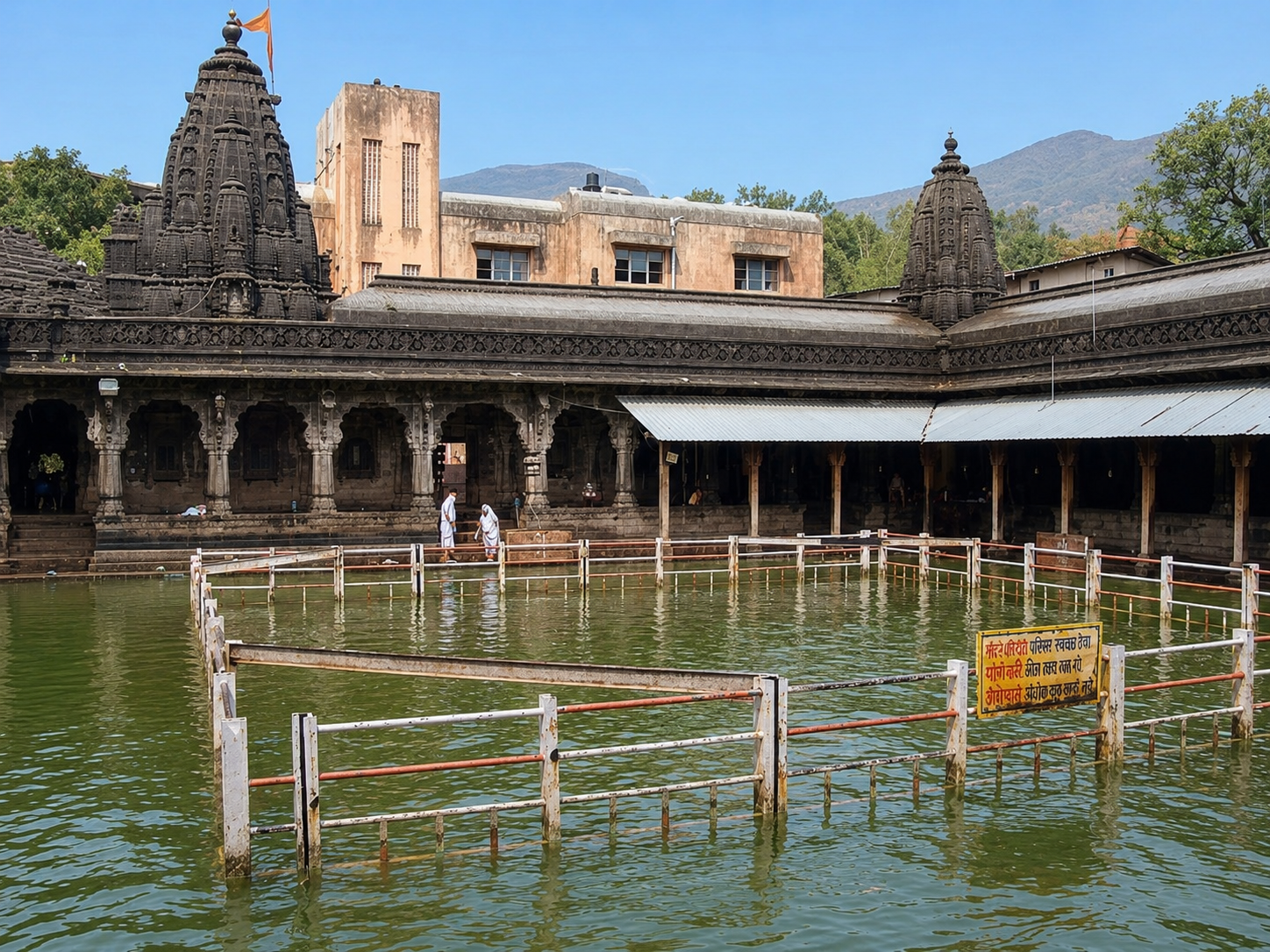
Although the river emerges from Brahmagiri, Kushavarta is revered as the point where its earthly journey formally begins.R26 The stone tank was rebuilt by Maratha rulers.D9
Its stone architecture, bathing ghats, daily Vedic ceremonies, purification observances, Shraddha and other ancestral rites make it integral to pilgrimage and Kumbh practice.
Devotees regard sacred bathing as an act of purification and inner renewal.
Riverbank worship is associated in faith with blessings, merit, prosperity, harmony and well-being.
Pitru Tarpan and Shraddha are performed for remembrance and peace of departed ancestors.
The traditional journey links the Jyotirlinga, Kushavarta Kund, Brahmagiri and the Godavari bathing ghats.
Quick Decision Box
Choose a practical plan for darshan, ritual guidance or the Brahmagiri circuit.
Darshan visit
Recommended for most visitors
Start Early
Use the approximate 5:30 AM opening and 6:00 AM general-darshan start as planning guidance.
A three-step journey to Trimbakeshwar Mandir in Trimbak, approximately 28–30 km west of Nashik.
1
Step 1
Reach the Nashik Region
Choose the most suitable air, rail or road arrival.
Air
Nashik Airport
Approximately 35 km from the Mandir; a direct taxi is listed at about 50–60 minutes. Mumbai airport is approximately 180 km / 4–5 hours by road.
Rail
Nashik Road Railway Station
Approximately 39 km / 60–90 minutes onward. Direct connections are listed from Mumbai, Pune, Delhi, Hyderabad, Ahmedabad, Nagpur and Varanasi.
Road
Highway and state-road access
Nashik is approximately 30 km away; regular bus and taxi options operate through the day.
Most convenient route: airport or railway station → Nashik → Trimbakeshwar Mandir.
2
Step 2
Continue to Trimbak
Use the source-supplied route and transfer options.
Taxi / Private Cab
Nashik to Trimbak
Approximately 45–60 minutes.
MSRTC / Shared Jeep
Bus every 15–30 minutes
Bus approximately 60–75 minutes; shared jeep approximately 60 minutes. Services are listed from Nashik Central Bus Stand, Mumbai, Pune and Shirdi.
Longer Routes
Mumbai, Pune and Shirdi
Mumbai via Thane, Kasara, Igatpuri and Nashik: approximately 180 km / 4–5 hours. Pune: approximately 240 km / 5–6 hours. Shirdi: approximately 120 km / 3 hours.
Popular circuit: Shirdi Sai Baba Mandir → Nashik → Trimbakeshwar.
3
Step 3
Final Mandir Access
Complete the town-centre approach on foot.
Town-Centre Walk
Main market road
The market road leads to the Mandir; walking distance from parking areas is approximately 5–10 minutes.
Accessibility
Temple-zone facilities
The supplied guide lists wheelchair and senior-citizen facilities near the temple zone; reconfirm current availability.
Trimbak Bazaar
Market-road access
Plan time for permitted puja items, Prasad and local purchases after darshan.
Live traffic, bus frequency, parking and accessibility arrangements should be reconfirmed.
Important Travel Note: Start early, allow festival and Shravan crowd buffers and wear suitable footwear for Brahmagiri routes.
Source-supplied planning hours and five daily ritual rows; festival schedules may differ.
Reconfirm before travel
General DarshanApproximately 6:00 AM onwardPlanning value from the supplied source, not a live queue reading.
Temple day5:30 AM to around 9:00 PM
Temple Opens5:30 AMApproximate source timeGeneral Darshan6:00 AMApproximate startTemple ClosesAround 9:00 PMSubject to current arrangementsFestival DaysSchedules differConfirm current information
Daily Aarti
Five Source-Supplied Ritual Times
Kakad Aarti5:30 AM
Morning Puja7:00 AM
Madhyana Aarti1:00 PM
Evening Aarti7:00 PM
Shayan Aarti8:30 PM
Timing note: Timings may vary during festivals, Shravan, Kumbh arrangements and special ritual days.TIME
Major Festivals
Five source-supplied observances linking Shiva worship, the Godavari and the Kumbh tradition.
February–March
Maha Shivaratri
The largest annual Mandir festival, with fasting, night-long Jagaran, continuous worship, Rudrabhishek, Abhishekam, Om Namah Shivaya chanting, milk, flowers, fruit and Bilva offerings, special aartis and discourses.
July–August
Shravan Maas
A high-footfall Shiva month, especially Shravan Somvars, with vows, fasting, Vedic chanting, Rudrabhishek, Mahamrityunjaya Jaap, Jyotirlinga decoration, extended darshan arrangements and Brahmagiri Parikrama.
Date varies
Godavari Janmotsav
Celebrates the river’s Brahmagiri emergence through Kushavarta puja, processions, Vedic chanting, river worship, holy bathing and cultural and spiritual programmes.
Approximately every 12 years
Kumbh Mela / Simhastha
Tradition links the region with Amrit drops from Samudra Manthan. Millions gather for Shahi Snan, holy bathing, satsang, yajnas, discourses and the presence of Akharas, saints and sadhus.
October–November
Kartik Purnima
A full-moon festival of bathing, Trimbakeshwar Abhishek, bhajans, aartis, river worship, Deepdan, illumination, charitable acts and prayers for peace and spiritual merit.
These festivals bring devotion, sacred-river practice and ancient ritual traditions together in honour of Lord Shiva and the Godavari.
Pooja and Ritual Guidance
Recognised ritual categories associated with Trimbakeshwar; verify the authorised process before arranging or paying.
Payment safety
Source-recognised category
Narayan Nagbali
Trimbakeshwar is widely associated with Narayan Nagbali rituals.RT1
ChannelAuthorised only
EligibilityConfirm first
Materials and chargesVerify before payment
Ancestor remembrance
Tripindi Shraddha
A specialist ancestral-rite category included in the supplied implementation requirements.
PriestVerify authorisation
DurationConfirm
PaymentUse verified counter/channel
Specialist ritual
Kaal Sarp Shanti
The source identifies Kaal Sarp Shanti and Pitru Dosha Nivaran among ritual traditions for which visitors travel to Trimbakeshwar.
Outcome claimsFaith-based
ArrangementsConfirm officially
Unofficial agentsAvoid
Shiva worship
Rudrabhishek
Rudrabhishek is prominent in Maha Shivaratri and Shravan observances and is included as a planning category.
Current timeReconfirm
Permitted materialsVerify
Booking sourceAuthorised only
Best Time to Visit
Season, crowd and hill conditions all affect a Trimbakeshwar pilgrimage.
Most balanced season
October to March
The supplied guide identifies these months as the preferred general planning season.
Highest-demand periods
Shravan and Maha Shivaratri
Expect very large crowds, especially on Shravan Mondays and major festival days.
Best daily start
5:30 AM–8:00 AM
Start early and keep timing buffers; this is planning guidance, not a live queue estimate.
Travel tips: Use comfortable footwear for Brahmagiri; monsoon steps can be slippery. A broader trip may combine Trimbakeshwar, Nashik Panchavati and Anjaneri Hills.
Nearby Sacred Places
Five source-supplied pilgrimage places around Trimbakeshwar.
Brahmagiri Hills
Approximately 2 km
Regarded in tradition as a sacred Shiva hill and earthly manifestation of Lord Shiva, the Godavari birthplace and a place of Gautama and Ganga memory, scripture and local tradition, meditation, penance and pilgrimage. Stone steps lead to source streams, Shiva shrines, caves, meditation places and valley views. The trek is popular in Shravan and Maha Shivaratri; beliefs about divine energy are matters of faith.
Kushavarta Kund
Adjacent to the Mandir complex
The stone kund is revered as the Godavari’s symbolic earthly source and supports sacred bathing, purification, Shraddha, ancestor rites and Kumbh ceremonies. Maratha-period stone architecture, bathing ghats and daily Vedic rituals shape its year-round atmosphere; beliefs about cleansing and merit are matters of faith.
Gangadwar
Approximately 3 km
A Brahmagiri cave shrine and early visible Godavari emergence point connected with Gautama’s penance and Ganga’s descent. Its natural spring, hilltop setting, worship areas and historic path make it a Brahmagiri pilgrimage stop associated in faith with purification, prosperity and liberation.
Anjaneri Hills
Approximately 20 km
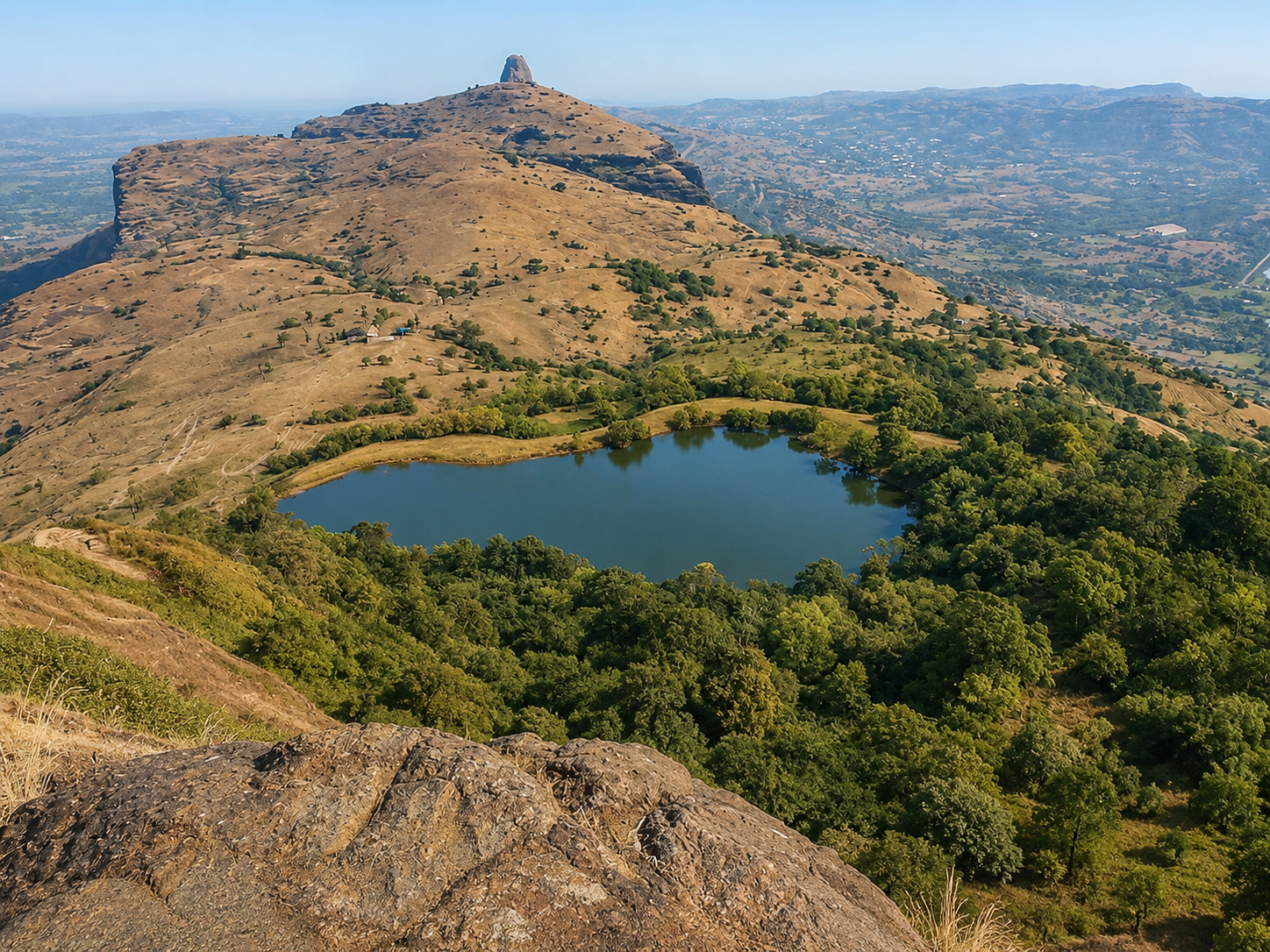
Named for Mata Anjani and traditionally believed to be Lord Hanuman’s birthplace.H14 This Ramayana-linked pilgrimage and trekking site includes Anjaneri Mandir, a birth-site shrine, rock-cut and Jain caves, Sahyadri trails and broad views. Devotional beliefs about courage, strength, protection and success are presented as tradition.
Gautameshwar Temple
Approximately 2 km
A shrine dedicated to Sage Gautama and linked with his penance and the Godavari origin legend. Its ancient Shiva shrine, traditional architecture and quiet sacred surroundings support prayer, contemplation and meditation and symbolise devotion, repentance and divine grace.
Trimbakeshwar Sacred Pilgrimage Circuit
The complete seven-stop sequence plus source-supplied half-day and full-day plans.
Seven-Stop Sacred Sequence
Stop
Sacred place
From previous
Mode / time
Importance
1
Trimbakeshwar Temple
Starting point
Walking / —
Eighth Jyotirlinga
2
Kushavarta Kund
100 m
Walk / 2–5 min
Sacred source kund of Godavari
3
Gautameshwar Temple
500 m
Walk / 5–10 min
Connected with Sage Gautama
4
Brahmagiri Hills
1.5 km
Walk/trek / 30–45 min
Godavari origin region
5
Gangadwar
1 km uphill
Trek / 20–30 min
Sacred Godavari emergence point
6
Return to Trimbak Town
2 km
Walk / 30–40 min
Rest and meals
7
Anjaneri Hills
20 km
Taxi / 30–40 min
Believed birthplace of Hanuman
Half-Day Pilgrimage Plan (4–5 Hours)
Early-morning source itinerary
Time
Activity
5:30 AM
Temple opening and Kakad Aarti
6:00 AM
Trimbakeshwar darshan
7:00 AM
Visit Kushavarta Kund
7:30 AM
Visit Gautameshwar Temple
8:00 AM
Begin Brahmagiri Hill climb
9:00 AM
Reach Gangadwar
10:00 AM
Return to temple area
11:00 AM
Local market and Prasad
Full-Day Sacred Circuit
Source itinerary through evening aarti
Time
Activity
5:30 AM
Temple darshan
7:00 AM
Kushavarta Kund
7:30 AM
Gautameshwar Temple
8:00–11:00 AM
Brahmagiri Hills and Gangadwar trek
11:30 AM
Return and lunch
1:00 PM
Explore Trimbak Bazaar
2:00 PM
Taxi to Anjaneri Hills
3:00–5:00 PM
Hanuman birthplace darshan
6:00 PM
Return to Trimbakeshwar
7:00 PM
Evening Aarti
All route distances and durations are approximate and depend on weather, access, crowd and physical fitness.
Offerings and Prasad
Source-supplied Prasad and sacred Shiva offerings; follow current Mandir rules.
Popular Prasad
Mandir Prasad
PanchamritSource listed
LaddooSource listed
MishriSource listed
Dry fruitsSource listed
Coconut offeringsSource listed
Sacred Godavari waterSource listed
Sacred flowers and offerings
Traditional Shiva Offerings
Bel PatraMost sacred for Shiva
White lotusPurity
White flowersDevotion
DhaturaTraditional Shiva offering
Aak flowersSacred worship
MilkAbhishek
HoneyPanchamrit ritual
Godavari waterHighly auspicious in tradition
Use only permitted offerings and authorised counters; current rules take precedence.
Visitor Information and Hill Safety
Prepare for Mandir controls, the Brahmagiri landscape, family needs and the Trimbak market road.
Hill conditions
Rain, Steps and Footwear
Monsoon rain can make black-stone and hill steps slippery. Check Brahmagiri access and weather, wear suitable footwear and carry water.
Family planning
Seniors and Children
Allow rest breaks and assess trekking suitability. Reconfirm wheelchair and senior-citizen facilities near the temple zone.
Mandir readiness
Security and Payments
Follow footwear, belongings, queue and prohibited-item rules. Carry minimum valuables and avoid unofficial ritual agents.
Famous market near the Mandir
Trimbak Bazaar
The source lists Rudraksha malas, Shiva idols, copper vessels, puja items, spiritual books, sacred Godavari souvenirs and traditional Maharashtrian sweets.
Frequently Asked Questions
Use approximately 5:30 AM opening, approximately 6:00 AM general darshan and around 9:00 PM closing as planning values, subject to current arrangements.
Use authorised counters or verified channels and confirm eligibility, priest, materials, duration and charges before payment.
No guarantee is made. Check current weather, hill access, crowd controls and physical suitability before starting.
Shravan, Shravan Mondays, Maha Shivaratri and Kumbh arrangements can bring very heavy demand and additional controls.
The source tradition connects the Godavari’s Brahmagiri origin, Gautama’s prayer, Kushavarta Kund and Trimbakeshwar Jyotirlinga.
The supplied source gives half-day and full-day itineraries, but real duration depends on access, weather, crowd, transport and physical fitness.
Reference Notes
Definitions for source markers used beside their first relevant public occurrence.
AR8 — Hemadpanthi architecture taxonomy; public wording uses “Hemadpanthi architecture”.
R11 — Ganga River, used only in the Gautama and sacred-descent tradition.
R12 — Godavari River sacred-geography reference.
R26 — Kushavarta Kund reference.
H5 — Brahmagiri Hills reference.
H12 — Western Ghats landscape reference.
H14 — Anjaneri Hills reference; birthplace wording remains a traditional belief.
C12 — Nashik–Trimbakeshwar Kumbh circuit and gathering reference.
D9 — Maratha-period Kushavarta stone reconstruction context.
RT1 — Narayan Nagbali ritual category.
REC — Source identifies the present structure with Nanasaheb Peshwa / Balaji Baji Rao and the eighteenth century.
TIME — Five daily ritual rows and general planning hours; current times must be reconfirmed.