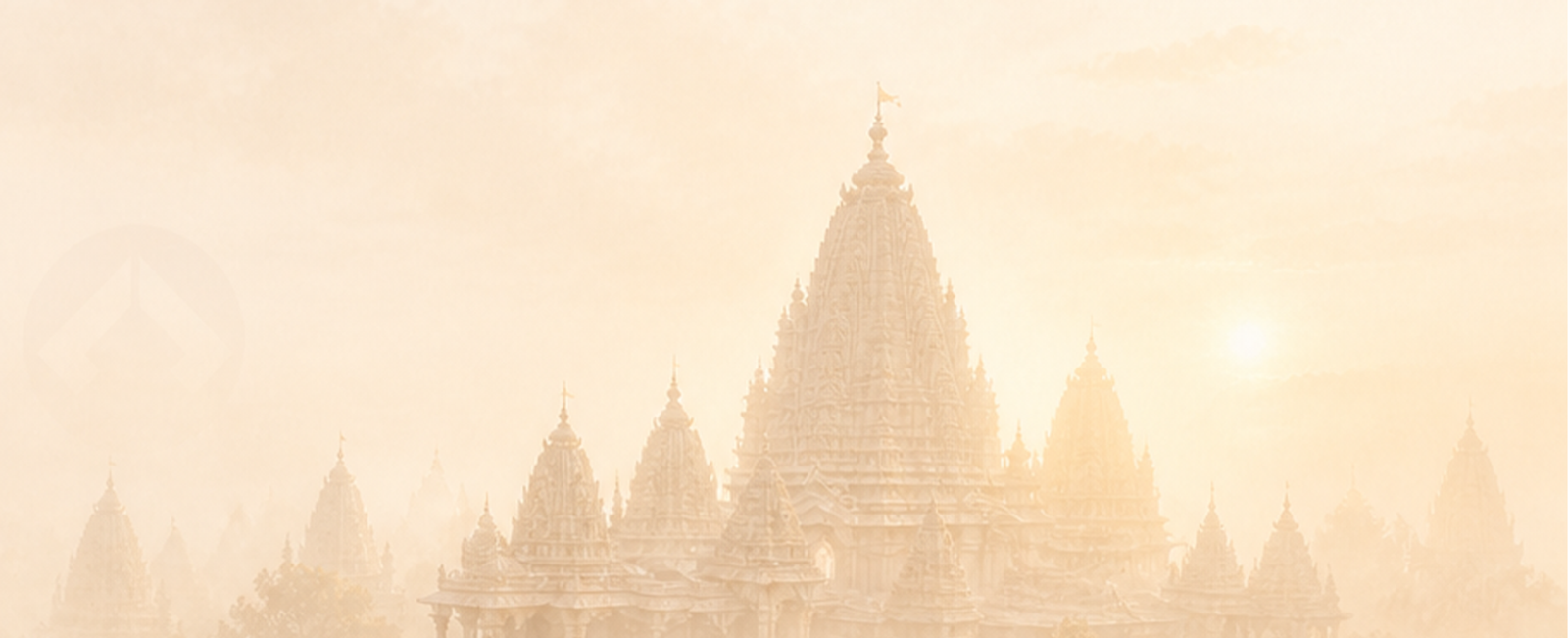
Raghunath
The main shrine centres on Lord Rama under the name Raghunath.
 Divine Mandir
Shri Raghunath Mandir, Raghunath Bazaar, Old Jammu City, Jammu, Jammu & Kashmir 180001, India
Jammu’s major Dogra-era temple complex, centred on Lord Rama as Raghunath and extending through seven interconnected shrines.
Visitor note: October to March generally offers cooler city conditions. Festival days are important and more crowded.
Source: DM-RM-005-A_JK.docx. Confirm current arrangements before travelling.
Jammu temple guide
Raghunath Temple stands in Old Jammu City and forms a complex of seven shrines. Lord Rama is worshipped as Raghunath in the principal temple.
The source records separate shrine contexts for Lakshmana, Sita and Hanuman rather than flattening them into a single sanctum ensemble. Maharaja Gulab Singh began the complex and Maharaja Ranbir Singh completed it.
Sanctum identity
Lord Rama worshipped as Shri Raghunath in the principal shrine.
The main shrine centres on Lord Rama under the name Raghunath.
The complex extends Rama worship through multiple temple chambers and sacred collections.
Lakshmana, Sita and Hanuman are associated with separate shrines in the wider complex.
Temple identity in context
The complex reflects the religious patronage of Jammu’s Dogra rulers.
Raghunath anchors a broader collection of Vaishnava images and Saligramas.
The historical library and manuscript tradition connect worship with Sanskrit scholarship.
Tradition carefully framed
Temple tradition connects the site with a sacred fire and the devotional vision of Maharaja Gulab Singh.
The complex developed as both a major Rama temple and a centre for Sanskrit learning under Maharaja Ranbir Singh.
Source-backed historical outline
Maharaja Gulab Singh initiated the temple in the nineteenth century.
Maharaja Ranbir Singh completed the complex and supported its manuscript and learning traditions.
Form, materials and setting
Seven shrines create a large interconnected sacred plan.
Tall shikharas define the skyline of the bazaar quarter.
The source describes Hindu, Sikh and Mughal-influenced decorative elements.
Gilded surfaces and painted panels enrich parts of the complex.
Numerous Saligramas and images extend beyond the principal Raghunath shrine.
The temple is embedded within historic Raghunath Bazaar.
What makes this temple distinct
The scale of the complex supports a longer internal circuit.
The source highlights an extensive collection associated with Vishnu worship.
Historical Sanskrit manuscripts and scholarship form part of the temple’s legacy.
Jammu often serves as the onward base for the separate Vaishno Devi pilgrimage.
Choose the planning path that fits your visit.
Visit fit
Raghunath darshan, seven-shrine circuit and Dogra heritage
Review guidanceSetting
Raghunath Bazaar in central Old Jammu
Review guidanceBest period
October to March generally offers cooler city conditions. Festival days are important and more crowded.
Review guidanceConfirm
Reconfirm timings, access, photography, offerings and festival controls before travel.
Review guidanceA source-supported visitor route; current directions take priority.
Begin at the principal shrine and follow the current route through the complex.
Continue through the associated shrines without assuming a compulsory order.
Visit the nearby Shiva temple if time allows.
Add one Jammu heritage stop according to transport and opening conditions.
Shri Raghunath Mandir, Raghunath Bazaar, Old Jammu City, Jammu, Jammu & Kashmir 180001, India
Source-reported schedule; reconfirm before travel
6:00 AM–12:00 PM source-reported
12:00 PM–2:00 PM source-reported
2:00 PM–8:00 PM source-reported
Temple schedules, festival access and local controls can change. Confirm the current programme with the responsible temple authority.
Principal source-listed celebrations
The principal Rama festival brings special worship.
The complex is illuminated during the festival associated with Rama’s return.
Vijayadashami observances recall Rama’s victory.
Open public remembrance in Roman script
Shri Ram Jai Ram Jai Jai Ram
A public form of remembrance that may be recited quietly and respectfully.
Sita Ram
A concise public remembrance preserving the Sita-Rama couple context.
Simple, public and non-initiatory
Use a clean space and a calm, attentive approach.
Water, flowers, fruit or a safe lamp may be used when appropriate and permitted.
Use public Rama Nama in Roman script and close with quiet prayer.
Formal temple rites belong to trained priests and the responsible temple authority. This page does not publish initiated or operational ritual instructions.
Continue to the Lord Ram hub
Follow current temple rules
Offer only where the temple currently permits them.
Use temple-approved counters and directed offering points.
Prefer authorised temple channels and obtain a receipt when available.
Weather, festivals and crowds
October to March generally offers cooler city conditions. Festival days are important and more crowded.
Weather, road conditions, queues and festival controls can change. Check close to the visit date.
Source-listed local and regional stops
Approximately 800 m; a major Shiva temple.
Open mapApproximately 3 km; the former Dogra royal palace.
Open mapApproximately 6 km; includes the Bawe Wali Mata shrine.
Open mapA Shiva cave shrine in Jammu.
Open mapApproximately 5 km; Dogra royal heritage.
Open mapThe historic market directly surrounding the temple.
Open mapA practical, optional route
This route is optional. Reorder or shorten it according to time, current access and personal needs.
Before you enter
The supplied module sources used for this guide
DM-RM-005-A_JK.docx is the primary source for temple identity, traditions, worship, visitor planning and nearby places.
The derived catalogue supports public Roman-script mantras and safe household-worship framing.
Opening hours, access, photography, transport and festival arrangements can change; reconfirm them close to travel.