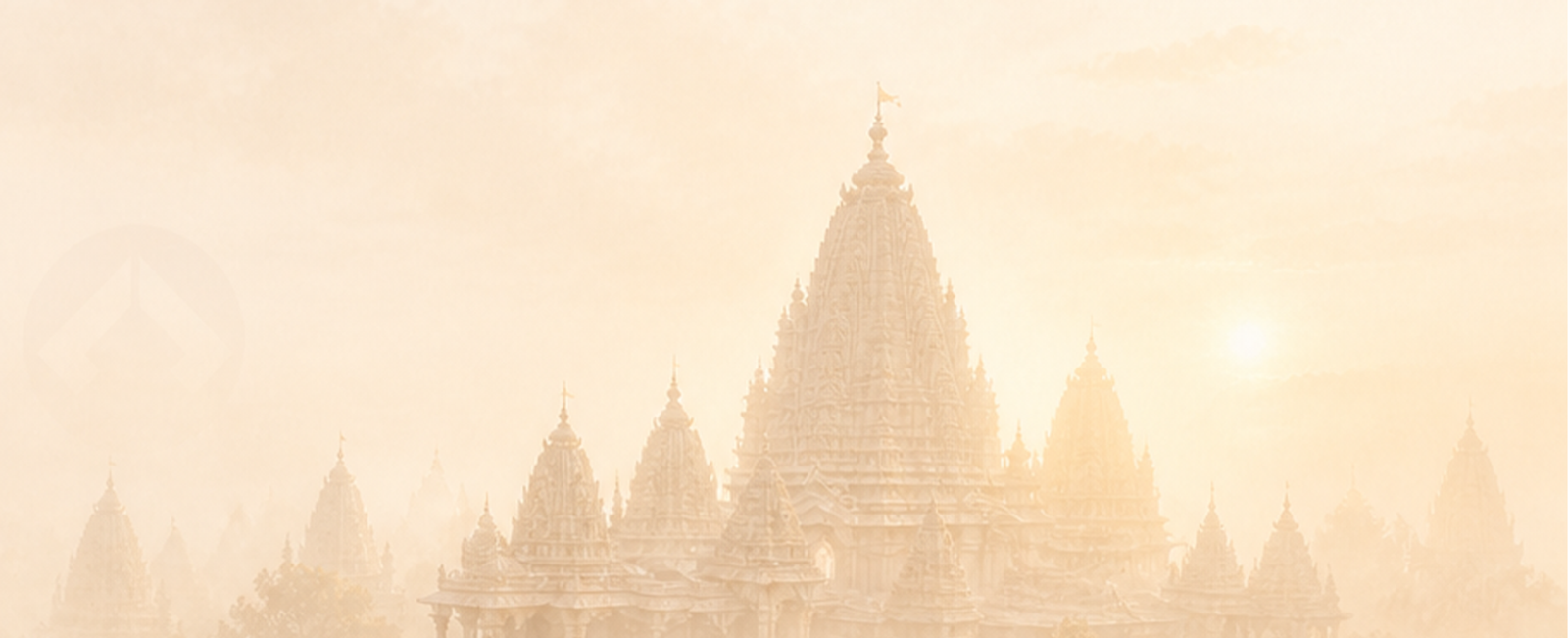
Raja Raman / Pattabhirama
Rama is enthroned in the peaceful coronation scene rather than a battle pose.
 Divine Mandir
Arulmigu Ramaswamy Temple, Ramaswamy Kovil Sannathi Street, Kumbakonam, Thanjavur District, Tamil Nadu 612001, India
Kumbakonam’s Pattabhirama temple presents Rama’s coronation with Sita, his three brothers and a seated musical Hanuman.
Visitor note: March to April brings Sri Rama Navami and larger crowds. Evenings are source-recommended for seeing the precinct murals under temple lighting.
Source: DM-RM-008-A_TN.docx. Confirm current arrangements before travelling.
Kumbakonam temple guide
Arulmigu Ramaswamy Temple stands in central Kumbakonam and worships Rama as Raja Raman or Pattabhirama. Rama and Sita sit together in coronation posture.
Lakshmana, Bharata and Shatrughna stand around the throne, while Hanuman is seated without a mace, holding the Ramayana and playing the veena. The full family ensemble is essential to the temple’s identity.
Sanctum identity
Rama as the enthroned Raja Raman or Pattabhirama, seated with Sita in coronation form.
Rama is enthroned in the peaceful coronation scene rather than a battle pose.
Sita, Lakshmana, Bharata and Shatrughna share the sanctum composition.
Hanuman sits with the Ramayana scroll and veena, without the usual mace.
Temple identity in context
The sanctum celebrates the culmination of the Ramayana and Rama’s coronation.
The complete royal family grouping gives the temple this devotional epithet.
Pillars and murals narrate the epic across the precincts.
Tradition carefully framed
Temple tradition recounts that images of Rama and Sita were found during excavation of a tank at Darasuram and inspired the Nayak royal foundation.
Govinda Dikshitar is remembered for overseeing construction and connecting the temple with Kumbakonam’s older sacred and commercial fabric.
Source-backed historical outline
Construction began under Achuthappa Nayak and was completed under Raghunatha Nayak.
The minister’s role is preserved in the temple’s building tradition and the Kadai Theru connection.
Form, materials and setting
The temple belongs to the sixteenth–seventeenth-century Nayak tradition.
A rajagopuram marks the main entrance.
Single-stone pillars carry carved Ramayana scenes.
Wall paintings narrate the epic in a circumambulatory sequence.
A substantial compound wall frames the precinct.
The iconographic programme culminates in the enthroned Rama family.
What makes this temple distinct
Rama, Sita, three brothers and Hanuman appear together.
The seated, scholarly-musical form is exceptionally distinctive.
Carved pillars and murals provide an extended visual narrative.
The temple belongs to Kumbakonam’s wider Vishnu and sacred-tank landscape.
Choose the planning path that fits your visit.
Visit fit
Pattabhirama darshan, Ramayana murals and Nayak architecture
Review guidanceSetting
Central Kumbakonam near Big Bazaar Street and Aadi Kumbeswarar Temple
Review guidanceBest period
March to April brings Sri Rama Navami and larger crowds. Evenings are source-recommended for seeing the precinct murals under temple lighting.
Review guidanceConfirm
Reconfirm timings, access, photography, offerings and festival controls before travel.
Review guidanceA source-supported visitor route; current directions take priority.
Begin with Pattabhirama darshan and the full sanctum ensemble.
Read the Ramayana carvings in the source-described order where possible.
Continue around the mural sequence without blocking worship circulation.
Add nearby Kumbakonam temples and the tank according to available time.
Arulmigu Ramaswamy Temple, Ramaswamy Kovil Sannathi Street, Kumbakonam, Thanjavur District, Tamil Nadu 612001, India
Source-reported schedule; reconfirm before travel
6:00 AM–12:00 PM source-reported
5:00 PM–9:00 PM source-reported
Six ritual periods are described; confirm festival changes
Temple schedules, festival access and local controls can change. Confirm the current programme with the responsible temple authority.
Principal source-listed celebrations
The principal temple festival in March–April.
The source records a processional visit to Mahamaham Tank.
A five-day annual ritual festival in the Tamil month of Adi.
Open public remembrance in Roman script
Shri Ram Jai Ram Jai Jai Ram
A public form of remembrance that may be recited quietly and respectfully.
Sita Ram
A concise public remembrance preserving the Sita-Rama couple context.
Simple, public and non-initiatory
Use a clean space and a calm, attentive approach.
Water, flowers, fruit or a safe lamp may be used when appropriate and permitted.
Use public Rama Nama in Roman script and close with quiet prayer.
Formal temple rites belong to trained priests and the responsible temple authority. This page does not publish initiated or operational ritual instructions.
Continue to the Lord Ram hub
Follow current temple rules
Offer only where the temple currently permits them.
Use temple-approved counters and directed offering points.
Prefer authorised temple channels and obtain a receipt when available.
Weather, festivals and crowds
March to April brings Sri Rama Navami and larger crowds. Evenings are source-recommended for seeing the precinct murals under temple lighting.
Weather, road conditions, queues and festival controls can change. Check close to the visit date.
Source-listed local and regional stops
A major Vishnu temple in Kumbakonam.
Open mapA nearby Shiva temple central to the town’s identity.
Open mapAn older Vishnu temple linked by Kadai Theru.
Open mapKumbakonam’s principal sacred tank.
Open mapA nearby UNESCO-listed Chola temple.
Open mapA longer regional Vaishnava extension at Srirangam.
Open mapA practical, optional route
This route is optional. Reorder or shorten it according to time, current access and personal needs.
Before you enter
The supplied module sources used for this guide
DM-RM-008-A_TN.docx is the primary source for temple identity, traditions, worship, visitor planning and nearby places.
The derived catalogue supports public Roman-script mantras and safe household-worship framing.
Opening hours, access, photography, transport and festival arrangements can change; reconfirm them close to travel.