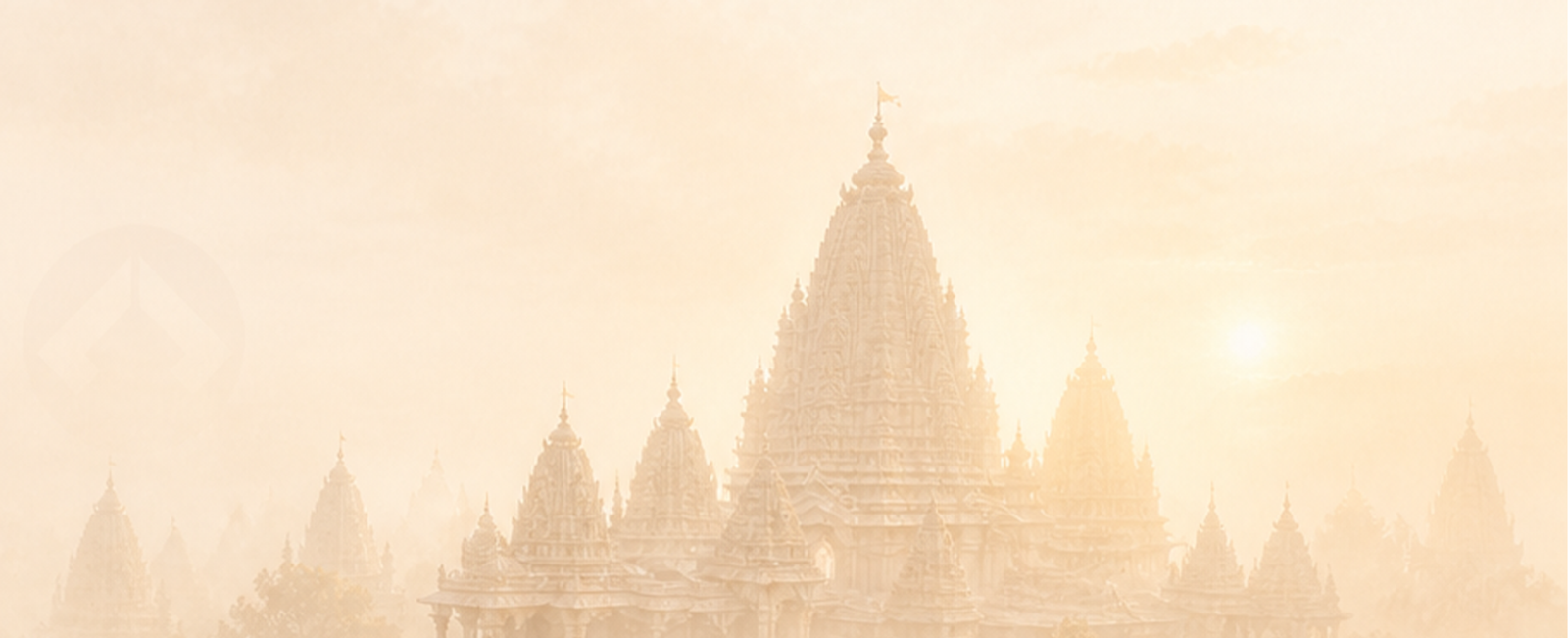
Marudhachalamurthy
The principal granite image faces east and is associated with staff and Vel iconography.
 Divine Mandir
Marudhamalai Adivaram, Coimbatore District, Tamil Nadu, India
A Western Ghats Murugan hill temple associated with the Marudham tree, Pambatti Siddhar tradition and an 837-step ascent.
Visitor information: Morning 6:00 AM-1:00 PM; evening 2:00 PM-8:00 PM. Hill access may be restricted after 7:00 PM. Current temple directions take priority.
Source: supplied temple research document DT-MU-007-A_TN.docx.
Coimbatore temple guide
Marudhamalai rises west of Coimbatore in the Western Ghats and is traditionally honoured as an additional Murugan abode beyond the canonical six.
The main ascent combines 837 steps with shuttle and road options. Forest Department controls may restrict late access because of wildlife movement.
Temple identity
The principal granite image faces east and is associated with staff and Vel iconography.
The simple ascetic presentation recalls the Dhandayuthapani form.
A local sacred tradition honours Murugan with Valli and Deivanai in the older shrine.
Form, place and tradition
Marudhamalai is popularly called a seventh abode, without replacing the canonical six.
A cave shrine preserves local traditions concerning the Siddhar's meditation.
The temple name and identity are linked with the Marudham tree and hill landscape.
Narrative presented with clear boundaries
The Pambatti Siddhar narrative describes spiritual redirection from snake-catching toward disciplined inward practice and devotion to Murugan.
Serpent imagery is treated as sacred symbolism. Kundalini or medicinal claims are not turned into do-it-yourself instruction or healthcare advice.
Literary memory and built fabric
The source cites Sangam-era literary associations and twelfth-century inscriptions using names connected with Marudhamalai.
The visible complex is described as Chola-period in origin with later Pandya and Nayaka additions.
Source-described spatial character
The shrine stands approximately 741 m above mean sea level.
The temple occupies the eastern face of the hill.
A sculpted gateway marks the main precinct.
Rest mandapams occur along the ascent.
A cave shrine lies at the southern side of the temple.
The older sacred focus is distinct from the principal granite image.
What makes this temple distinct
A source-described feature of Marudhamalai Murugan Temple; confirm current visitor access and interpretation locally.
A source-described feature of Marudhamalai Murugan Temple; confirm current visitor access and interpretation locally.
A source-described feature of Marudhamalai Murugan Temple; confirm current visitor access and interpretation locally.
A source-described feature of Marudhamalai Murugan Temple; confirm current visitor access and interpretation locally.
A source-described feature of Marudhamalai Murugan Temple; confirm current visitor access and interpretation locally.
A source-described feature of Marudhamalai Murugan Temple; confirm current visitor access and interpretation locally.
Choose a visit plan that fits current conditions.
A Western Ghats Murugan hill temple associated with the Marudham tree, Pambatti Siddhar tradition and an 837-step ascent.
Morning 6:00 AM-1:00 PM; evening 2:00 PM-8:00 PM. Hill access may be restricted after 7:00 PM.
City buses reach the foothill; hilltop access by approximately 837 steps, temple shuttle or permitted private vehicle
Reconfirm timings, access, photography, offerings and festival controls before travel.
A practical route, not a compulsory pilgrimage order.
Current on-site directions always take priority.
Current on-site directions always take priority.
Current on-site directions always take priority.
Current on-site directions always take priority.
Current on-site directions always take priority.
Current on-site directions always take priority.
City buses reach the foothill; hilltop access by approximately 837 steps, temple shuttle or permitted private vehicle
Published source schedule; confirm before travel.
Check the current official schedule, especially on festival, eclipse or special-service days.
Temple calendar and regional context
A ten-day Brahmotsavam and the largest local festival period.
A six-day observance with temple-managed worship.
A marriage-themed festival.
The hill temple is illuminated for the lamp festival.
One short public Roman formula
Om Subrahmanyaya Namah
Meaning: A simple public salutation to Subrahmanya.
Context: This open public formula is optional; no fixed count or guaranteed result is claimed.
Pray briefly for courage, wisdom, ethical action and the welfare of all. Use a safe lamp or a flameless alternative, and avoid initiated formulas or improvised fire rites.
Respectful participation
Join only the public darshan and worship arrangements currently offered by the temple.
Formal archana, abhisheka, homa, kavadi and other vows remain temple-led or guided practices. No piercing, extreme fasting, hazardous carrying or fire rite is presented as compulsory.
No medical, fertility, marriage, exam, prosperity, victory, enemy-destruction or dosha-removal outcome is guaranteed.
Five focused topics in the Murugan hub.
Simple, authorised and responsible
Use only items the temple currently accepts and present them only at authorised points.
Clean flowers, fruit and other modest offerings may be suitable when locally approved.
Avoid plastic and food waste. Do not describe offerings, prasada or sacred water as medical treatment.
Season and crowd planning
November to March is generally cooler; Thaipusam is the largest crowd period.
An early non-festival visit may be easier, but queues are never guaranteed.
Check heat, rain, road, forest, river and festival conditions relevant to this specific temple.
Optional extensions, not compulsory stops
Approximately 12 km. A major Shiva temple in Coimbatore's sacred landscape.
Open mapApproximately 15 km. A prominent Ganesha shrine on Pollachi Road.
Open mapApproximately 30 km. A separate sacred hill region requiring its own access planning.
Open mapCoimbatore region. A river in the wider Kongu landscape.
Open mapApproximately 50 km. A historic Shiva temple with inscriptions relevant to the region.
Open mapApproximately 105 km. The third Arupadai Veedu and a longer Murugan pilgrimage extension.
Open mapA suggested sequence that may be reordered.
This is not an official compulsory pilgrimage order. Reorder stops according to access, weather, time and mobility.
Before you enter
Source-led scope and verification boundary
Primary source read in full for identity, location, timings, travel, tradition, history, architecture, festivals and nearby places.
Current information should be checked with marudhamalaimurugan.hrce.tn.gov.in.
Used only for public Roman mantras, safe household devotion, festival framing, regional identity and publication boundaries.