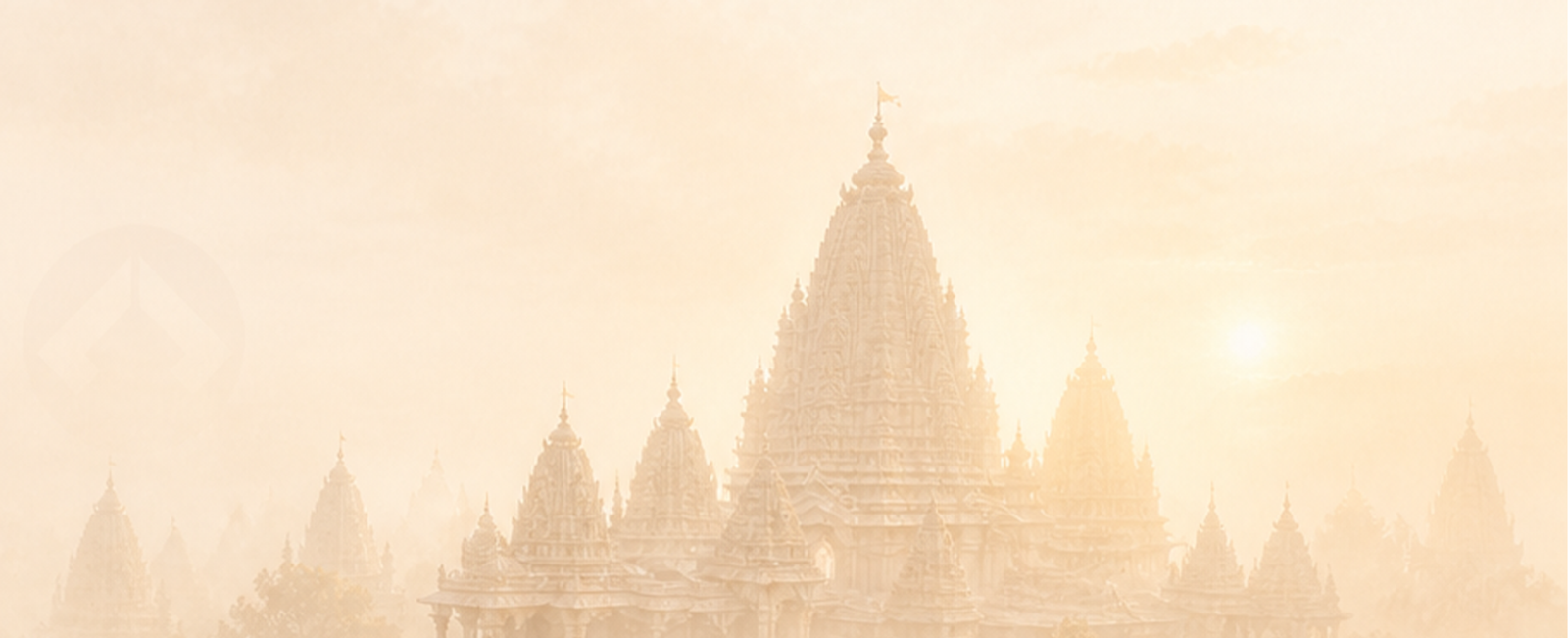
Subrahmanya with both consorts
The central form is Sri Subrahmanyaswamy with Valli and Devasena.
 Divine Mandir
Kamakotinagar, Padmarao Nagar, Hyderabad District, Telangana, India
A hillock temple in Secunderabad established under Kanchi Kamakoti guidance, with Subrahmanya, Valli and Devasena at the centre of a six-fold worship complex.
Visitor information: Hours vary by weekday; all listed evening sessions close at 9:00 PM. Current temple directions take priority.
Source: supplied temple research document DT-MU-009-A_TG.docx.
Secunderabad temple guide
Skandagiri Temple stands on a small hillock in Padmarao Nagar and is a prominent Subrahmanya centre for Hyderabad and Secunderabad.
The complex follows a Shanmatha presentation with shrines representing Ganesha, Shiva, Subrahmanya, the Goddess, Vishnu and Surya-related worship.
Temple identity
The central form is Sri Subrahmanyaswamy with Valli and Devasena.
The temple reflects the devotional life of the twin cities and should retain its Telangana identity.
The source describes an early period when the deity is seen before daily decoration.
Form, place and tradition
The site developed from a 1960s devotional committee and Kanchi Paramacharya guidance.
Multiple major Hindu worship streams are represented in one temple.
The temple is popularly called a seventh Padai Veedu, without altering the canonical Tamil six.
Narrative presented with clear boundaries
Temple history records a 1961 devotional committee, the choice of the hillock under Kanchi Paramacharya's guidance and foundation work in 1968.
Rahu-Ketu and other temple services belong to local institutional practice. This guide does not diagnose planetary doshas or promise marriage, fertility, health or career outcomes.
Literary memory and built fabric
The foundation ceremony took place on 18 May 1968. Sundara Vinayagar was consecrated later that year, and the principal Subrahmanya shrine in January 1970.
Additional Kamakshi, Ekambareshwarar, Navagraha, Jaya Durga and Varadarajaswamy shrines followed in the 1970s.
Source-described spatial character
The complex is arranged on Skandagiri above Padmarao Nagar.
A sculpted South Indian gateway marks the approach.
The main shrine houses Subrahmanya with Valli and Devasena.
Shrines across six worship streams form a unified complex.
Steps and a lift support the final approach.
Major shrines were added between 1968 and 1978.
What makes this temple distinct
A source-described feature of Skandagiri Temple; confirm current visitor access and interpretation locally.
A source-described feature of Skandagiri Temple; confirm current visitor access and interpretation locally.
A source-described feature of Skandagiri Temple; confirm current visitor access and interpretation locally.
A source-described feature of Skandagiri Temple; confirm current visitor access and interpretation locally.
A source-described feature of Skandagiri Temple; confirm current visitor access and interpretation locally.
A source-described feature of Skandagiri Temple; confirm current visitor access and interpretation locally.
Choose a visit plan that fits current conditions.
A hillock temple in Secunderabad established under Kanchi Kamakoti guidance, with Subrahmanya, Valli and Devasena at the centre of a six-fold worship complex.
Hours vary by weekday; all listed evening sessions close at 9:00 PM.
Urban access through Padmarao Nagar; narrow lanes and limited roadside parking favour cab, auto-rickshaw or public transport
Reconfirm timings, access, photography, offerings and festival controls before travel.
A practical route, not a compulsory pilgrimage order.
Current on-site directions always take priority.
Current on-site directions always take priority.
Current on-site directions always take priority.
Current on-site directions always take priority.
Current on-site directions always take priority.
Current on-site directions always take priority.
Urban access through Padmarao Nagar; narrow lanes and limited roadside parking favour cab, auto-rickshaw or public transport
Published source schedule; confirm before travel.
Check the current official schedule, especially on festival, eclipse or special-service days.
Temple calendar and regional context
The principal large annual festival.
A six-day festival followed by Devasena Kalyanam.
An important anniversary-linked Subrahmanya observance.
A festival connected with the devotional committee that preceded the temple.
One short public Roman formula
Om Subrahmanyaya Namah
Meaning: A simple public salutation to Subrahmanya.
Context: This open public formula is optional; no fixed count or guaranteed result is claimed.
Pray briefly for courage, wisdom, ethical action and the welfare of all. Use a safe lamp or a flameless alternative, and avoid initiated formulas or improvised fire rites.
Respectful participation
Join only the public darshan and worship arrangements currently offered by the temple.
Formal archana, abhisheka, homa, kavadi and other vows remain temple-led or guided practices. No piercing, extreme fasting, hazardous carrying or fire rite is presented as compulsory.
No medical, fertility, marriage, exam, prosperity, victory, enemy-destruction or dosha-removal outcome is guaranteed.
Five focused topics in the Murugan hub.
Simple, authorised and responsible
Use only items the temple currently accepts and present them only at authorised points.
Clean flowers, fruit and other modest offerings may be suitable when locally approved.
Avoid plastic and food waste. Do not describe offerings, prasada or sacred water as medical treatment.
Season and crowd planning
October to February is generally cooler; Tuesdays, Fridays and major festivals are busier.
An early non-festival visit may be easier, but queues are never guaranteed.
Check heat, rain, road, forest, river and festival conditions relevant to this specific temple.
Optional extensions, not compulsory stops
Approximately 5 km. A major Secunderabad goddess temple associated with Bonalu.
Open mapApproximately 7 km. An urban lake and public landmark between the twin cities.
Open mapApproximately 10 km. A hill temple dedicated to Venkateswara.
Open mapApproximately 12 km. A Kalinga-style urban temple.
Open mapApproximately 15 km. A historic Hanuman shrine in Hyderabad.
Open mapApproximately 70 km. A longer regional pilgrimage extension.
Open mapA suggested sequence that may be reordered.
This is not an official compulsory pilgrimage order. Reorder stops according to access, weather, time and mobility.
Before you enter
Source-led scope and verification boundary
Primary source read in full for identity, location, timings, travel, tradition, history, architecture, festivals and nearby places.
Current information should be checked with srisubrahmanyaswamydevalayamskandagiri.org.
Used only for public Roman mantras, safe household devotion, festival framing, regional identity and publication boundaries.