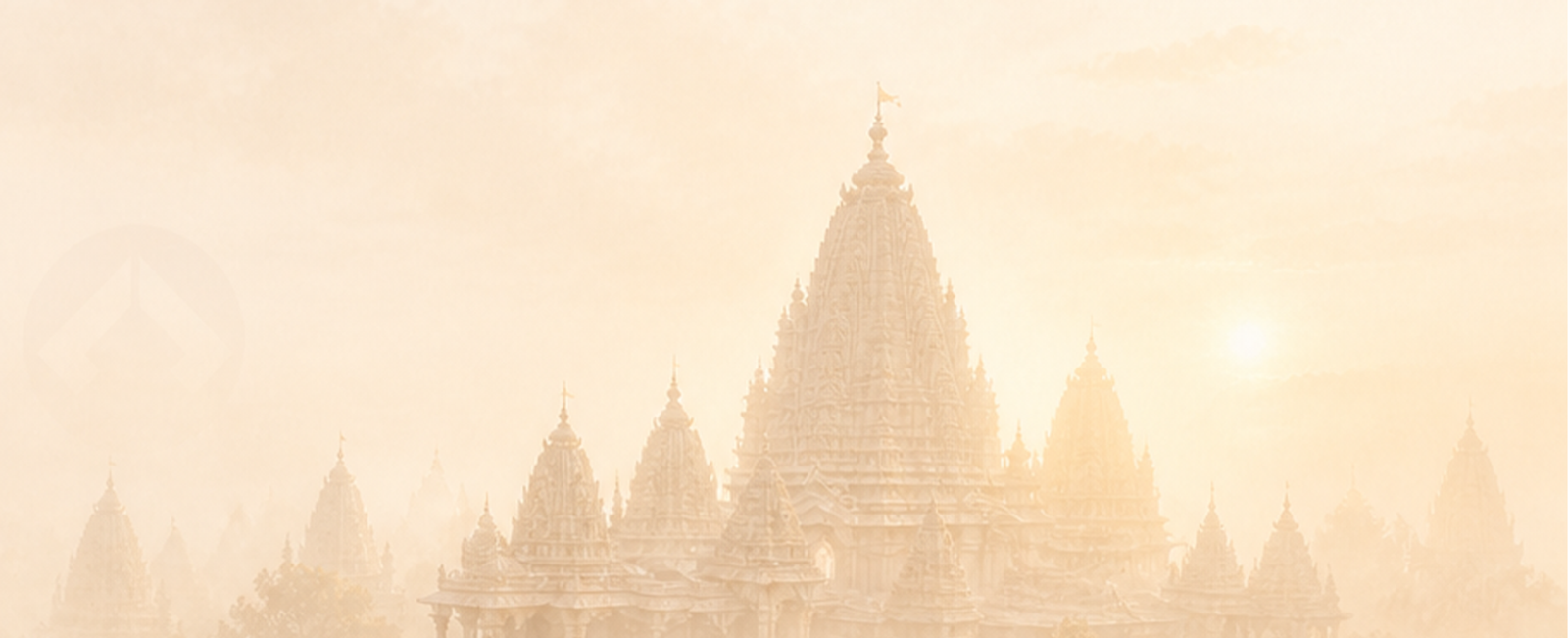
Presiding form
Lord Ranganatha reclining on Adisesha with Goddess Ranganayaki
 Divine Mandir
Srirangam, Tiruchirappalli District, Tamil Nadu, India
A major living temple-town centred on Lord Ranganatha in a reclining form, with seven concentric enclosures, numerous shrines and a long Sri Vaishnava history.
Visitor planning: October to March; Vaikunta Ekadasi brings the principal festival crowds. Check current timings and access close to travel.
Primary factual source: DT-VI-001-A_TN.docx.
Srirangam temple guide
A major living temple-town centred on Lord Ranganatha in a reclining form, with seven concentric enclosures, numerous shrines and a long Sri Vaishnava history.
Temple-town on Srirangam island between the Cauvery and Kollidam rivers.
Temple-specific sanctum identity
Lord Ranganatha reclining on Adisesha with Goddess Ranganayaki. This form and its local names are retained as supplied rather than reduced to a generic Lord Vishnu label.
Lord Ranganatha reclining on Adisesha with Goddess Ranganayaki
Srirangam Temple, Peria Koil, Thiruvaranga Tirupathi, Bhuloka Vaikuntam
Approach quietly and follow current sanctum directions.
The sacred identity in context
The reclining Ranganatha form, south-facing sanctum tradition and the temple-town’s concentric approach shape the devotional identity of Srirangam.
A major living temple-town centred on Lord Ranganatha in a reclining form, with seven concentric enclosures, numerous shrines and a long Sri Vaishnava history.
Temple-town on Srirangam island between the Cauvery and Kollidam rivers
Sri Vaishnavism, Tenkalai tradition and Pancharatra Agama
Tradition carefully framed
Temple tradition connects the sacred form with Brahma, the Ikshvaku lineage, Rama and Vibhishana. The account explains why Ranganatha faces south and is presented as sacred tradition rather than independently documented chronology.
Traditional narratives convey devotional meaning and are not presented as independently documented chronology.
Source-led historical context
Temple tradition connects the sacred form with Brahma, the Ikshvaku lineage, Rama and Vibhishana. The account explains why Ranganatha faces south and is presented as sacred tradition rather than independently documented chronology.
Chola, Pandya, Hoysala, Vijayanagara and Nayaka patronage contributed to the complex over many centuries. Sri Ramanujacharya is closely associated with Srirangam, and the present Rajagopuram was completed in 1987.
Temple form and built features
Tamil (Dravidian) architecture. Accretion of building activity over centuries from 1st century CE. Chola, Pandya, Hoysala, Vijayanagara and Nayaka contributions.
156 acres (63.131 hectares). Largest functioning Hindu temple in the world.
7 concentric rectangular enclosures. Total wall length over 6 miles (32,592 feet). Inner 5 enclosures = temple. Outer 2 = settlement.
21 gopurams total. Largest concentration in any Indian temple. Rajagopuram: 236 ft (72 m), 13 tiers, completed 1987. Vellai Gopuram: main daily entrance.
Ananda Nilayam (Abode of Bliss). Gold-plated dome over sanctum. Shaped like Tamil 'Om'. Said to be from Krta Yuga.
Lord Ranganatha reclining on Adisesha in Yoga Nidra. Faces south (unique). Gold-plated vimana above.
Approach and worship space
Enter through the current visitor gateway and move through the successive prakarams toward the sanctum.
Follow current footwear, queue, photography and sanctum instructions throughout the visit.
What makes this temple distinct
Seven concentric enclosures organise the temple-town approach.
The southern gateway rises to approximately 72 metres.
A gold-plated vimana crowns the sanctum.
The source records hymns associated with all twelve Alvars.
Sri Ramanujacharya’s shrine is an important part of the complex.
The island lies between the Cauvery and Kollidam rivers.
Choose a practical planning path.
Visit fit
A major living temple-town centred on Lord Ranganatha in a reclining form, with seven concentric enclosures, numerous shrines and a long Sri Vaishnava history.
View guidanceSeason
Allow additional time during festival periods.
View guidanceApproach
Enter through the current visitor gateway and move through the successive prakarams toward the sanctum.
View guidancePlanning
Confirm timings, entry and accessibility close to travel.
View guidanceA practical eight-step flow; current on-site directions take priority.
Arrive in Srirangam with enough time for the final approach and current queue arrangements.
Wear modest clothing, keep footwear and belongings where directed, and follow security instructions.
Enter through the current visitor gateway and move through the successive prakarams toward the sanctum.
Use the entry, circulation and waiting areas indicated by temple staff.
Temple-town on Srirangam island between the Cauvery and Kollidam rivers. Move carefully and keep passageways clear.
Approach Lord Ranganatha reclining on Adisesha with Goddess Ranganayaki quietly and keep the queue moving.
Visit associated shrines in the order permitted on site and do not assume one ritual applies everywhere.
Receive authorised prasada if available, collect belongings and continue to nearby places only if desired.
Travel to Srirangam using the source-recorded connections. Distances are approximate.
Source-recorded split visiting periods
6:00–7:15 AM; 9:00 AM–12:00 PM
Source-recorded visitor period.
1:15–6:00 PM; 6:45–9:00 PM
Source-recorded visitor period.
Temple operations, festivals and local arrangements can alter the schedule. Check with temple administration close to travel.
Temple and Sri Vaishnava observances
A major Srirangam observance with the Paramapada Vasal tradition and extended festival activity.
Processions and temple observances take place according to the annual temple calendar.
The festival tradition centres on the divine wedding of Ranganatha and Ranganayaki.
Safe public devotional context
Quiet prayer, respectful darshan and listening to authorised temple recitation are appropriate public contexts.
This guide does not publish initiation-governed recitation, nyasa, mudra, yantra, homa or consecration procedures.
Respectful participation
Daily temple worship follows authorised priestly and temple traditions. Visitors may attend public darshan, remain quiet during worship and follow directions without attempting to reproduce temple procedures.
Continue with five focused topics in the Lord Vishnu hub.
Follow current temple arrangements
Tulsi, flowers, fruit and other simple offerings should be presented only through current temple arrangements.
Season and crowd planning
October to March; Vaikunta Ekadasi brings the principal festival crowds.
Prefer a quieter non-festival morning when practical.
Allow extra time during major observances.
Carry water where permitted and plan for seasonal heat.
Optional regional stops
Flows around Srirangam island, adjacent to the temple. The River Cauvery is one of the most sacred rivers in South India. The temple is situated on an island formed by the Cauvery and its tributary Kollidam. The river is considered holier than the Ganges in the Tamil tradition. The Cauvery and Kollidam encircle the Srirangam shrine. Lord Ranganatha reclines on the banks of the Cauvery. The river is associated with the legend of Vibhishana placing the idol on its banks.
Open mapFlows on the northern side of Srirangam island. The River Kollidam is a tributary of the Cauvery that forms the northern boundary of the Srirangam island. Together with the Cauvery, the Kollidam encircles the Srirangam shrine. Tirumalisai Alvar referred to the Kauvery and Kollidam encircling the shrine in his hymns. The river is considered sacred by devotees visiting Srirangam.
Open mapApproximately 3 km from Srirangam. The Jambukeswarar Temple at Thiruvanaikaval is one of the Pancha Bhoota Sthalams (five elemental Shiva temples), representing the element of water (Jala). The temple has an underground water stream that continuously emerges in the sanctum. The temple is dedicated to Lord Shiva as Jambukeswarar with Goddess Akilandeswari. It is located on the opposite bank of the Cauvery from Srirangam.
Open mapApproximately 5 km from Srirangam. The Rockfort Temple is situated on a massive rock outcrop in the heart of Tiruchirappalli city. The temple complex has two main shrines: Ucchi Pillayar (Lord Ganesha) at the top and Thayumanavar (Lord Shiva) at the base. The rock is one of the oldest geological formations in the world, estimated at over 3 billion years.
Open mapApproximately 130 km from Srirangam (in Karnataka). The Sri Ranganathaswamy Temple at Srirangapatna is the first of the Triranga (Three Rangas) pilgrimage circuit. It is known as Adi Ranga (the first Ranga). The temple is one of the Pancharanga Kshetrams (five Ranganatha temples along the Cauvery). The deity is Lord Ranganatha in a reclining posture similar to Srirangam. Srirangam is the Antya Ranga (the final Ranga) of this circuit.
Open mapApproximately 20 km from Srirangam. The Samayapuram Mariamman Temple is one of the most important Amman (Goddess) temples in Tamil Nadu. The temple is dedicated to Goddess Mariamman, a form of Goddess Parvati. The temple attracts large crowds of devotees, especially on Tuesdays and Fridays. The temple is known for its unique offerings including miniature cradles and metallic body parts representing prayers for healing.
Open mapA compact optional route around the source-backed temple.
This is a suggested visitor route, not an official compulsory pilgrimage order. Reorder stops around current access, weather and personal mobility.
Before you enter
Temple-specific visitor answers
Source boundaries for this guide
Primary source for temple identity, coordinates, history, architecture, festivals and visitor context.
Derived catalogue used for safe public devotional boundaries and the five hub links.
Timings, access, offerings and festival operations may change; consult current temple administration close to travel.