
Four-faced form
Brahma is traditionally represented with four faces. Temple descriptions also refer to a seated image with four arms, while exact hand-held objects and material are best understood from on-site interpretation.
Pushkar, Ajmer District, Rajasthan, India
One of India’s few and best-known dedicated Lord Brahma temples, set within Pushkar’s sacred lake and pilgrimage landscape.
Official Notice / Visitor Information: Published summer hours are 5:00 AM–1:30 PM and 3:00 PM–9:00 PM. Published winter hours are 6:00 AM–1:30 PM and 3:00 PM–8:30 PM. The schedule includes an afternoon closure; confirm festival-day and local schedule changes before travel.
Source: Incredible India — Brahma Temple. Confirm the current schedule before travelling.
Pushkar temple guide
Jagatpita Shri Brahma Mandir is one of India’s few and best-known dedicated Brahma temples. It stands close to Pushkar Lake and forms a major focus of the town’s pilgrimage landscape.
The temple is especially associated with Kartika Purnima and the wider Pushkar pilgrimage season. Temple darshan, traditional bathing at the lake and the cultural Pushkar Fair are related parts of the season, but they are distinct activities.
Sanctum focus
Lord Brahma is the principal deity. Current public sources support a life-size four-faced Brahma form on a lotus and associate Gayatri with Brahma in the Pushkar sanctum tradition.
Brahma is traditionally represented with four faces. Temple descriptions also refer to a seated image with four arms, while exact hand-held objects and material are best understood from on-site interpretation.
Gayatri is represented with Brahma in the Pushkar sanctum tradition. Gayatri, Savitri and Saraswati are not treated as automatically interchangeable names.
Approach the sanctum quietly, keep the queue moving and follow current temple directions.
Creation and pilgrimage
The temple is one of India’s few and best-known shrines dedicated principally to Lord Brahma.
In common iconographic interpretation, Brahma’s four faces are connected with the four directions and the four Vedas.
The lotus, hamsa motif and nearby sacred lake shape the temple’s devotional identity without implying promised spiritual outcomes.
Pushkar tradition, carefully framed
According to Pushkar temple tradition, Brahma defeated Vajranabha with a lotus, and fallen lotus petals marked the formation of Pushkar’s sacred lakes. The account continues with Brahma preparing a yajna at Pushkar and Savitri arriving after the appointed ritual time.
According to this narrative, Gayatri joined Brahma so the yajna could be completed within the auspicious period. Savitri’s curse is used within the tradition to explain why dedicated Brahma temples are comparatively rare. These accounts convey sacred meaning and are not presented as independently documented chronology.
The same local tradition connects Savitri Temple on Ratnagiri Hill with this narrative.
Tradition and documented fabric
The shrine’s sacred tradition is older than the surviving architectural fabric. Temple traditions associate the site with Sage Vishwamitra and Adi Shankara.
The present temple lineage is broadly attributed to the medieval period and the 14th century. Institutional records document later repairs and reconstruction, including an important rebuilding phase in 1809, making a multi-phase account the most responsible summary.
High-platform Pushkar shrine
The temple is an east-facing pancharatha shrine with an axial approach toward the sanctum.
A raised platform and prominent flight of steps shape both its appearance and visitor access.
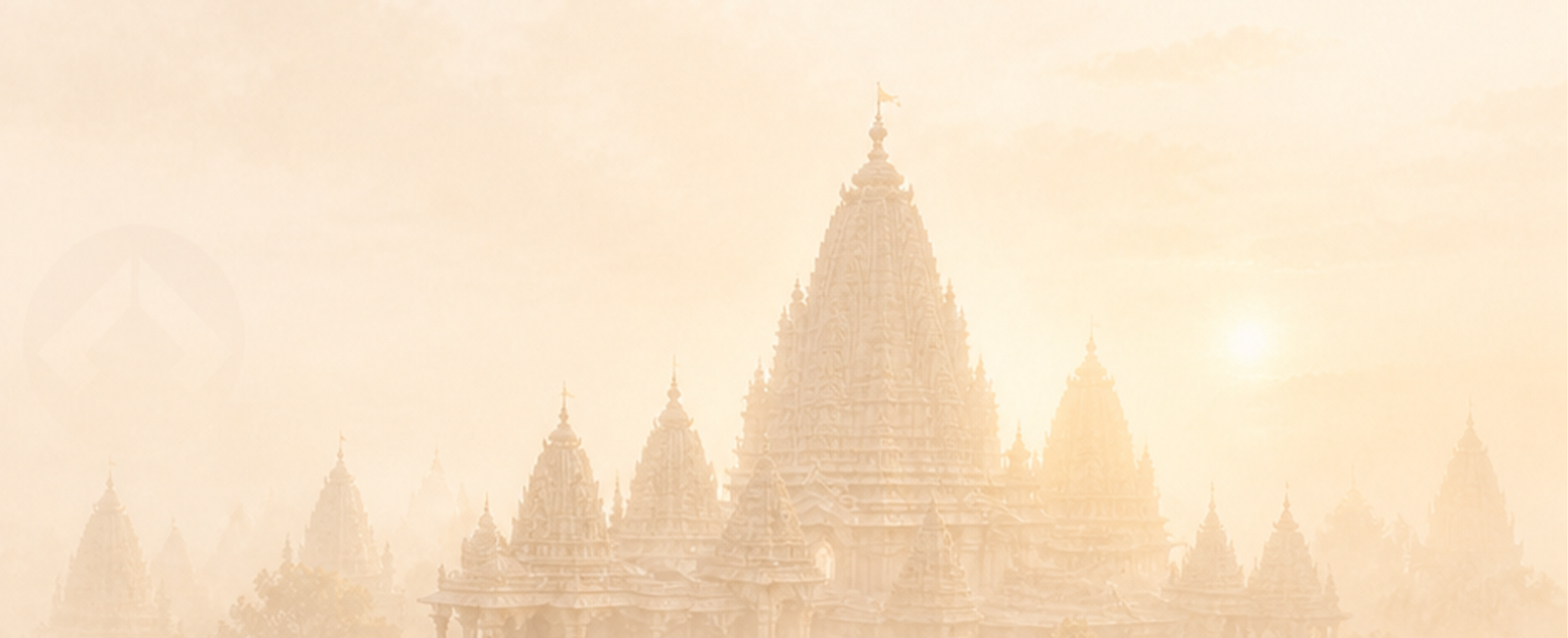
The red shikhara and hamsa motif are widely recognised exterior features.
The supported plan includes an entrance structure, mandapa or mukhamandapa, vestibule and square sanctum.
Stone and marble, a black-and-white floor and historic silver details contribute to the temple’s layered character.
The complex belongs to a larger network of lanes, ghats and temples around Pushkar Lake.
Approach and worship space
Steps rise to the east-facing temple’s high platform and entrance before the mandapa, vestibule and square sanctum. The approach begins from Brahma Mandir Road.
Historical accounts describe a sanyasi priesthood and restricted sanctum access. Visitors should follow current on-site instructions rather than treating an older account as an absolute present-day rule.
What makes the visit distinct
One of India’s few and best-known temples dedicated principally to Lord Brahma.
The sanctum tradition centres on four-faced Brahma with Gayatri association.
Recognisable elements of the temple’s supported architectural description.
The elevated approach is an important mobility consideration.
Accounts describe silver-coin inlays and a silver turtle; never place objects on temple surfaces without permission.
The lake and ghats form the surrounding ritual landscape without making bathing compulsory for entry.
Choose the planning path that fits your visit.
Visit fit
Brahma worship, Pushkar pilgrimage tradition, architecture and sacred narratives.
Typical duration: Allow about 1–2 hours, plus queue and nearby-stop time.
Plan darshanSeason and crowds
Generally the milder period. Kartika Purnima is the most important pilgrimage period and brings much heavier crowds and local controls.
Compare visit periodsMobility and family care
The high-platform approach matters for elderly visitors, children and anyone with limited mobility. Current step-free assistance was not publicly confirmed.
Review access guidanceConfirm before visiting
Photography rules were not publicly confirmed. Reconfirm the seasonal schedule, entry, offerings, photography, parking and accessibility before travel.
Use reference notesA practical eight-step flow. Current on-site directions always take priority.
Allow time for pedestrian movement around the ghats and Brahma Mandir Road.
Follow it only if personally appropriate; bathing is not an admission requirement.
Continue toward the temple’s stepped, high-platform approach.
Follow current footwear, security and worship-space instructions.
Use the route directed by temple staff and keep circulation areas clear.
Approach Lord Brahma’s sanctum respectfully and follow access directions.
Ask before presenting any item and use only directed offering points.
Nearby sacred places are an optional continuation, not a compulsory order.
Pushkar is approximately 15 km from Ajmer. Travel times vary with traffic and festival controls.
Published visitor information provides seasonal opening periods with an afternoon closure.
Seasonal hours may change during festivals and local arrangements; confirm the current schedule before travelling.
Temple-specific aarti times were not publicly confirmed in the reviewed current sources. Ask at the temple or verify locally before planning around an aarti.
Temple, lake and town observances
The full moon of Kartika, usually in October or November, is the principal annual pilgrimage period associated with Brahma worship at Pushkar. The Gregorian date changes each year.
The annual fair combines livestock trading, cultural events and tourism with the Kartika pilgrimage season. It is not one continuous Brahma Temple ritual.
Devotional gatherings are associated with full-moon and new-moon days. Confirm any current temple-specific programme locally.
Navaratri belongs to the wider devotional calendar of Pushkar, but is not presented as this temple’s principal annual festival.
Two concise Lord Brahma invocations for personal devotional reflection.
Om Prajapataye Namah
Meaning: Salutations to Lord Brahma, honoured as Prajapati, the lord of created beings.
Context: A devotional formula supplied in the temple source; it is not presented as an officially prescribed daily mantra of the Pushkar temple.
Om Aim Hreem Kleem Sah Om Prajapataye Namah
Meaning: A devotional invocation combining sacred seed syllables with salutations to Brahma as Prajapati, associated in the supplied source with spiritual wisdom and creative energy.
Context: No guaranteed spiritual, creative or material result is claimed.
Respectful participation
Worship centres on darshan of Lord Brahma. Visitors may also follow the Pushkar Lake pilgrimage tradition and the local Gayatri- and Savitri-associated sacred circuit when personally appropriate.
Historical accounts describe worship and offerings guided by sanyasi priests. Follow current temple instructions for sanctum access, queues and offerings rather than treating an older account as an absolute present-day rule.
No current named seva, fixed mantra count, unsupervised fire ritual, price or guaranteed devotional outcome is published here.
Continue with five focused topics in the Lord Brahma hub.
Confirm current arrangements
Historical and devotional accounts describe silver coins offered by devotees and inlaid into temple surfaces.
Current accepted offerings and prasad arrangements should be confirmed at the temple.
Do not place coins, silver items or other objects on temple surfaces without permission.
Season and crowd planning
These months generally offer milder conditions for a Pushkar visit.
Choose this period for the principal pilgrimage atmosphere, while expecting much heavier crowds and local controls.
An earlier visit may be easier outside festival peaks, but queues and waiting times are never guaranteed.
Walking stops and optional regional extensions
Adjacent; walking distance. The sacred lake and ghats form the ritual landscape around the temple. Bathing is a personal tradition, not an entry requirement.
Open mapApproximately 2 km. Plan for an uphill approach and check current ropeway status locally before relying on it.
Open mapApproximately 1 km. A historic temple dedicated to Lord Varaha and an important stop in Pushkar’s sacred landscape.
Open mapApproximately 1 km. A Shiva temple associated in local tradition with Brahma’s yajna and the wider Pushkar circuit.
Open mapApproximately 2 km. A Vishnu temple noted for its South Indian architectural character and tall gateway.
Open mapApproximately 15 km. An optional regional extension combining Ajmer’s historic city landscape with Ana Sagar Lake.
Open mapRegional Ajmer district context. A wider Aravalli landscape reference, not a walking-distance temple stop.
Open mapApproximately 145 km. A longer regional extension with major heritage and transport connections.
Open mapWithin Pushkar town. The setting for the annual livestock and cultural fair, distinct from temple darshan and lake worship.
Open mapBetween Ajmer and Pushkar. An Aravalli landmark on the connecting road, noted for the surrounding hill landscape.
Open mapA compact route connecting the temple with the wider sacred town.
This is a suggested visitor route, not an official compulsory pilgrimage order. Reorder stops according to current access, weather and personal mobility.
Before you enter
Public destination and institutional material used for careful framing.
Primary source for temple-specific identity, local context, traditions, worship, festivals, travel, nearby places and visitor-sequence material.
Official tourism context for identity, significance, history, architecture, Gayatri association and Kartika pilgrimage.
Open referenceCentral government tourism source for published seasonal hours, visitor context, transport, architecture and temple tradition.
Open referenceInstitutional evidence for the temple plan, orientation, repairs and reconstruction history.
Open referenceInstitutional site record supporting the complete Brahma Mandir Road address.
Open referenceOfficial destination context for Pushkar Lake, the four-faced image, hamsa and red-spire descriptions.
Open referenceOfficial festival context used to distinguish the wider fair from temple worship and lake observance.
Open referenceHeritage database used with a second mapping source to corroborate the reviewed coordinates.
Open referenceOpening hours, access rules, local transport and festival arrangements can change. Reconfirm time-sensitive details close to your visit.